

Types of Hangers for Stores
Retail fashion solutions designed to improve product display, facilitate operations, optimise retail fixtures, and move towards more circular models.
At Erum, we develop hangers for stores and retail fashion solutions designed to accompany each garment throughout its entire journey. From in-store presentation to logistics, reuse, recovery and recirculation, each hanger can become a tool to improve efficiency, durability and impact.
Designed to hang garments functionally, organise the retail space and facilitate day-to-day operations, our solutions help each garment be presented better and circulate more efficiently.
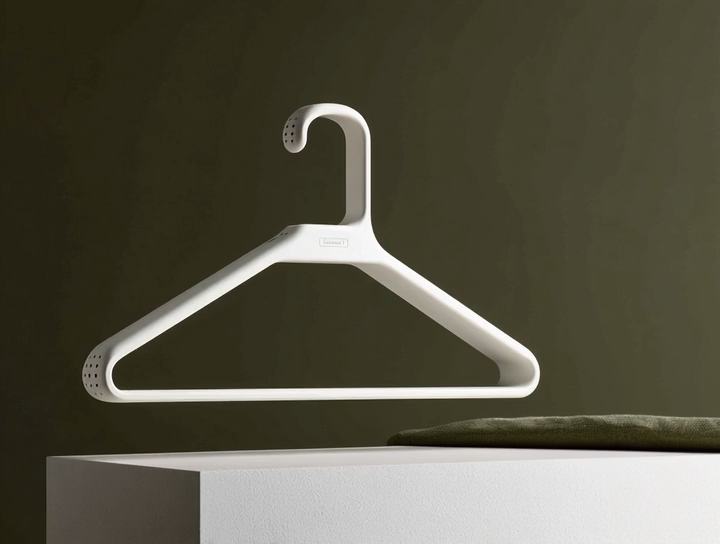
Choosing the right hanger matters
Choosing between different types of hangers for stores means thinking about more than just the format. Each garment needs suitable support, but each retail operation also needs durable, efficient solutions designed for circularity. A good hanger improves presentation, makes in-store work easier, helps save space on the rail, and can be integrated into recovery, sorting, reuse or recycling systems.
In retail fashion, hangers are part of retail fixtures and play a direct role in how products for sale are organised, displayed and managed. That is why their design must meet both aesthetic criteria and operational needs.
Types of hangers for stores by garment
| Hanger type | Main use | Value for retail |
|---|---|---|
| Hangers for upper garments | Shirts, blouses, jackets, T-shirts and dresses | Support drape, stability and a consistent in-store presentation |
| Hangers for lower garments | Trousers, skirts and shorts | Provide secure hold, strength and ease of handling |
| Hangers for sets | Suits, complete looks or coordinated garments | Help organise the display and improve the product’s visual readability |
| Hangers for knitwear | Knitwear and delicate garments | Reduce deformation and improve garment care |
| Children’s hangers | Children’s fashion | Adapt proportions, strength and usability to the garment size |
| Special hangers | Heavy garments, accessories or specific needs | Meet specific technical, operational or presentation requirements |
Types of hangers by material or finish
The different models of hangers for stores can be adapted to the type of garment, the display format, the rail design, the product volume and the specific needs of each retailer.
Lightweight, durable solutions optimised for hanging garments in high-volume retail operations.
Designed to provide stability, functionality and efficiency in garment presentation.
Options tailored to specific needs for image, feel, grip or in-store differentiation.
Alternatives associated with a warmer, more natural or premium presentation within retail fixtures.
Durable, visually lightweight solutions, suitable for certain spaces, garments or store concepts.
The hanger as an operational asset
In retail fashion, a hanger accompanies the garment at different moments along its journey. It can play a role in transport, storage, display, in-store handling, recovery and recirculation.
It also influences how rails are organised, how products for sale are displayed, and how available space is used in the store or warehouse.
That is why its design must meet both aesthetic criteria and operational, logistics and circular needs.
Frequently asked questions about hangers for stores
What types of hangers for stores are there?
There are hangers for upper garments, lower garments, sets, knitwear, children’s fashion and special solutions depending on the type of garment, weight, fabric and in-store use.
They can also be differentiated by material, finish, strength, functionality or integration within retail fixtures.
Which hanger is best for a clothing store?
It depends on the type of garment, brand image, turnover volume, required strength, available rail space, and the possibility of reuse or recycling.
They can also be differentiated by material, finish, strength, functionality or integration within retail fixtures.
Can hangers for stores help save space?
Yes. A well-designed hanger can help save space on rails, in warehouses and in transport systems, especially when working with large volumes of garments or products for sale.
The design, thickness, strength and shape of the hanger directly influence the efficiency of the available space.
Can hangers for stores be reused?
Yes. When they are designed for it and integrated into a suitable system, they can be collected, sorted, reused, repaired or recycled.
This approach makes it possible to reduce waste and move towards more circular models within retail fashion.
What materials are used in retail hangers?
Different materials can be used depending on the store’s needs, although in circular models, recycled, recyclable materials designed for multiple use cycles are particularly important.
Why is the hanger important in retail fashion?
Because it influences garment presentation, handling, in-store order, logistics, the durability of the support, and the possibility of integrating it into a circular system.
In addition, it is part of retail fixtures and directly affects how products for sale are organised, displayed and managed.